Dhanteras 2026: 11 Powerful Mantras to Chant, Their Benefits, Jaap Vidhi, Shubh Muhurat and Complete Puja Guide
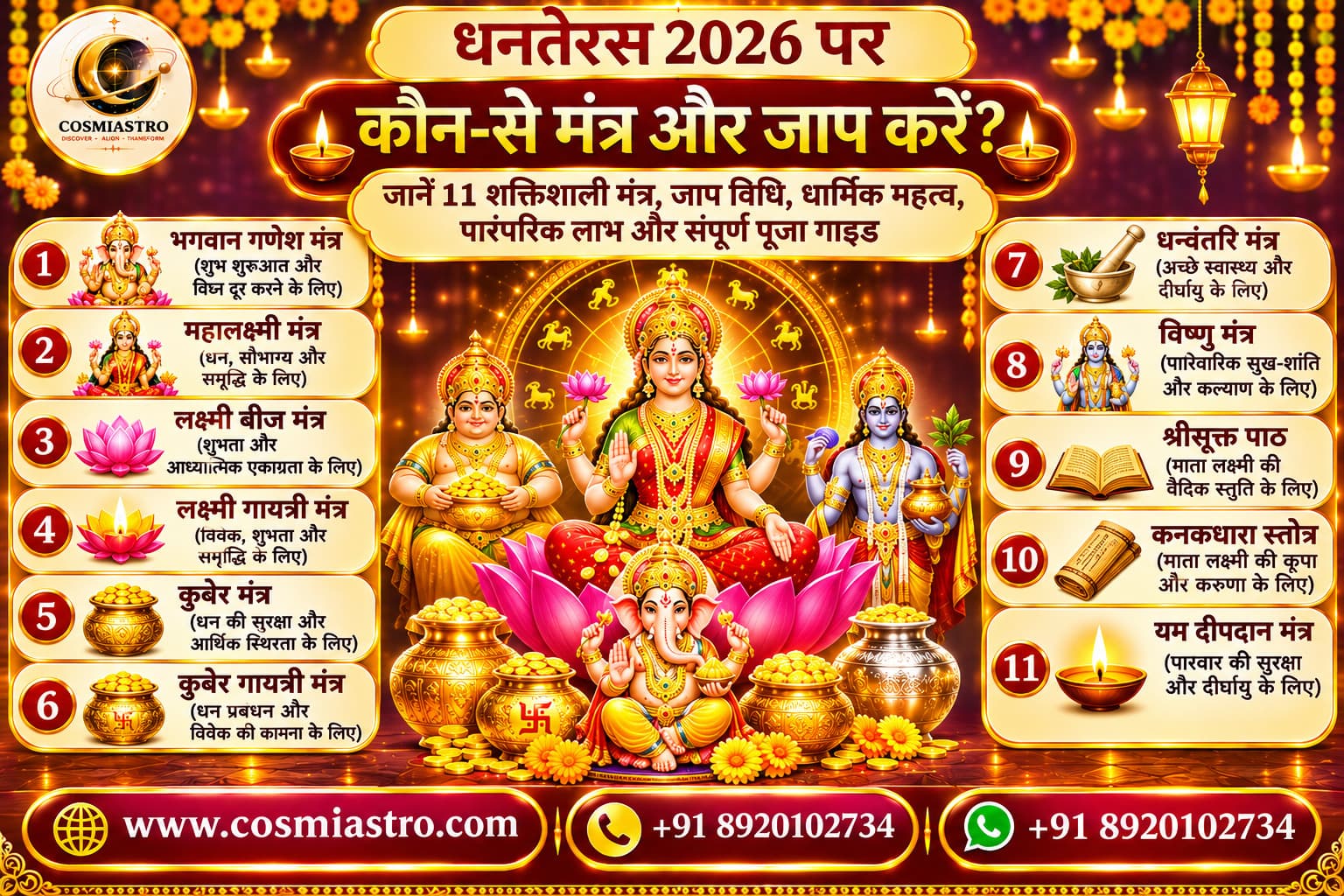
Dhanteras 2026 is one of the most auspicious festivals in Hindu tradition, celebrated with prayers for wealth, prosperity, good health, happiness, and family well-being. It marks the beginning of the five-day Diwali festivities and holds special importance for devotees of Goddess Lakshmi, Lord Kubera, and Lord Dhanvantari.
On Dhanteras, people traditionally purchase gold, silver, utensils, and other useful items. However, shopping is only one part of the celebration. Mantra chanting, devotional prayers, puja rituals, charity, and Yama Deepdaan are also important practices associated with the festival.
Many devotees have questions about Dhanteras mantras. Which mantra should be chanted for wealth? Which mantra is associated with financial stability? Why is Lord Dhanvantari worshipped? How many times should a mantra be repeated? Is chanting 108 times compulsory? Can someone perform Dhanteras mantra jaap without a priest?
In this comprehensive guide by Cosmiastro, discover 11 important mantras, chants, and sacred recitations associated with Dhanteras worship. Learn their Sanskrit texts, meanings, traditional benefits, chanting methods, recommended timings, and religious significance.
This article also explains Dhanteras 2026 puja muhurat, step-by-step worship procedures, common mistakes, and frequently asked questions.
1. Dhanteras 2026 Date, Shubh Muhurat and Important Details
Dhanteras 2026 will be celebrated on Friday, November 6, 2026, in India.
According to the Hindu calendar, Dhanteras falls on Krishna Paksha Trayodashi during the month of Kartik.
It is also known as Dhantrayodashi and Dhanvantari Jayanti.
Important Dhanteras 2026 Details
Dhanteras Date: Friday, November 6, 2026
Hindu Month: Kartik
Tithi: Krishna Paksha Trayodashi
Trayodashi Begins: November 6, 2026, at approximately 10:30 AM
Trayodashi Ends: November 7, 2026, at approximately 10:47 AM
Dhanteras Puja Muhurat: 6:02 PM to 7:57 PM
Pradosh Kaal: 5:33 PM to 8:09 PM
Vrishabha Kaal: 6:02 PM to 7:57 PM
These timings are based on the New Delhi Panchang and are expressed in Indian Standard Time.
The exact timings may differ depending on your city. Always consult a reliable local Panchang before performing time-specific rituals.
2. Why Is Mantra Chanting Important on Dhanteras?
In Hindu spiritual traditions, a mantra is a sacred sound, word, or collection of words recited during worship and meditation.
Mantra chanting is commonly called Mantra Jaap or Japa.
Devotees chant mantras to express devotion, remember a deity, develop concentration, and pray for particular blessings.
On Dhanteras, mantras associated with Goddess Lakshmi, Lord Kubera, and Lord Dhanvantari receive special attention.
Goddess Lakshmi represents prosperity, abundance, and auspiciousness.
Lord Kubera is traditionally regarded as the guardian of wealth.
Lord Dhanvantari is associated with Ayurveda, healing, and good health.
Lord Ganesha is worshipped at the beginning of auspicious ceremonies.
Lord Vishnu is associated with preservation, protection, and spiritual well-being.
The traditional benefits described in this article are based on religious beliefs. Mantra chanting should not be considered a scientifically proven method of obtaining money, eliminating debt, curing illness, or guaranteeing success.
3. Eleven Important Mantras and Sacred Chants for Dhanteras 2026
Mantra 1: Lord Ganesha Mantra for Auspicious Beginnings
Sanskrit Mantra
ॐ गं गणपतये नमः।
English Transliteration
Om Gam Ganapataye Namah.
Meaning
This mantra is an invocation to Lord Ganesha, who is traditionally worshipped as the remover of obstacles and the deity of wisdom and auspicious beginnings.
Why Chant This Mantra on Dhanteras?
Lord Ganesha is commonly worshipped before other deities during Hindu religious ceremonies.
Devotees chant this mantra while praying for clarity, wisdom, and the removal of obstacles.
Traditional Benefits
It is associated with auspicious beginnings, spiritual focus, wisdom, and the ability to face challenges with confidence.
How to Chant
Sit comfortably in a clean place.
Begin by remembering Lord Ganesha.
Chant the mantra slowly and respectfully.
Some devotees repeat it 11 or 21 times before beginning Lakshmi-Kubera Puja.
There is no universal requirement to follow a particular count.
Mantra 2: Mahalakshmi Mantra for Wealth and Prosperity
Sanskrit Mantra
ॐ श्रीं महालक्ष्म्यै नमः।
English Transliteration
Om Shreem Mahalakshmyai Namah.
Meaning
This mantra is an invocation to Goddess Mahalakshmi, traditionally associated with prosperity, abundance, and good fortune.
Why Chant This Mantra?
Dhanteras is closely associated with the worship of Goddess Lakshmi.
Devotees chant this mantra while praying for financial stability, household happiness, and the wise use of resources.
Traditional Benefits
The mantra is associated with prayers for prosperity, auspiciousness, gratitude, and spiritual well-being.
How to Chant
Prepare a clean worship area.
Place an image or idol of Goddess Lakshmi on a clean platform.
Offer flowers and other puja materials according to your family tradition.
Light a diya safely.
Chant the mantra with concentration.
Some traditions recommend 11, 21, or 108 repetitions.
Important Advice
Chanting this mantra does not guarantee sudden wealth. Financial stability also requires responsible earning, budgeting, and saving.
Mantra 3: Lakshmi Beej Mantra for Auspiciousness
Sanskrit Mantra
ॐ श्रीं।
English Transliteration
Om Shreem.
Meaning
Shreem is traditionally regarded as a seed syllable, or Beej Mantra, associated with Goddess Lakshmi.
Why Chant This Mantra?
In certain Shakta and devotional traditions, the syllable Shreem is used during the worship of Goddess Lakshmi.
Traditional Benefits
It is symbolically associated with abundance, beauty, harmony, and auspiciousness.
How to Chant
Sit in a peaceful place and focus on the deity.
Recite the syllable clearly and without rushing.
Follow the pronunciation and chanting method taught within your family or spiritual tradition.
Important Precaution
Some spiritual lineages prescribe specific initiation or guidance for particular Beej Mantra practices.
If you follow such a lineage, seek guidance from a qualified teacher before beginning an intensive practice.
Mantra 4: Lakshmi Gayatri Mantra for Wisdom and Prosperity
Sanskrit Mantra
ॐ महालक्ष्म्यै च विद्महे विष्णुपत्न्यै च धीमहि। तन्नो लक्ष्मीः प्रचोदयात्॥
English Transliteration
Om Mahalakshmyai Cha Vidmahe Vishnupatnyai Cha Dhimahi, Tanno Lakshmih Prachodayat.
Meaning
The prayer invokes Goddess Mahalakshmi, the consort of Lord Vishnu, and asks for divine inspiration and guidance.
Why Chant This Mantra?
The Lakshmi Gayatri is a devotional prayer emphasizing not only prosperity but also wisdom and spiritual awareness.
Traditional Benefits
Devotees associate it with clarity, auspiciousness, devotion, and responsible decision-making.
How to Chant
Recite the mantra during Lakshmi Puja or at another suitable time according to your tradition.
Some devotees repeat it 11 or 21 times.
Correct pronunciation and sincere devotion are more important than rushing through a large number of repetitions.
Mantra 5: Lord Kubera Mantra for Financial Stability
Sanskrit Mantra
ॐ यक्षाय कुबेराय वैश्रवणाय धनधान्याधिपतये धनधान्यसमृद्धिं मे देहि दापय स्वाहा॥
English Transliteration
Om Yakshaya Kuberaya Vaishravanaya Dhanadhanyadhipataye Dhanadhanyasamriddhim Me Dehi Dapaya Swaha.
Meaning
This mantra invokes Lord Kubera, traditionally regarded as the guardian of wealth and resources, while expressing a prayer for abundance.
Why Chant This Mantra on Dhanteras?
Lord Kubera is an important deity associated with Dhanteras worship.
His worship represents the desire for financial security and the responsible management of wealth.
Traditional Benefits
The mantra is associated with prayers for prosperity, financial stability, and the protection of resources.
How to Chant
Place an image or idol of Lord Kubera near the worship area.
Offer flowers and incense according to your custom.
Chant the mantra slowly.
Some devotees chant it 11, 21, or 108 times.
Practical Message
Financial stability also depends on avoiding unnecessary debt, maintaining savings, and making informed financial decisions.
Mantra 6: Kubera Gayatri Mantra for Financial Wisdom
A commonly used devotional version is:
Sanskrit Mantra
ॐ वैश्रवणाय विद्महे धनाध्यक्षाय धीमहि। तन्नो कुबेरः प्रचोदयात्॥
English Transliteration
Om Vaishravanaya Vidmahe Dhanadhyakshaya Dhimahi, Tanno Kuberah Prachodayat.
Meaning
The mantra invokes Lord Kubera as the guardian of wealth and seeks his guidance and inspiration.
Why Chant This Mantra?
Devotees use this prayer while reflecting on prosperity, financial responsibility, and the importance of protecting resources.
Traditional Benefits
It is associated with financial wisdom, disciplined thinking, and prayers for stability.
How to Chant
Chant it during Kubera Puja or another suitable devotional period.
Some traditions suggest 11 or 21 repetitions.
Different versions of Kubera Gayatri are found in devotional practice. Follow the wording recognized by your family or spiritual teacher.
Mantra 7: Lord Dhanvantari Mantra for Health and Well-Being
Sanskrit Mantra
ॐ धन्वन्तरये नमः।
English Transliteration
Om Dhanvantaraye Namah.
Meaning
This mantra is an invocation to Lord Dhanvantari, the divine figure traditionally associated with Ayurveda and healing.
Why Chant This Mantra on Dhanteras?
Dhanteras is also celebrated as Dhanvantari Jayanti.
According to the Samudra Manthan legend, Lord Dhanvantari appeared holding a vessel of Amrit.
His worship reminds devotees that good health is one of life's greatest forms of wealth.
Traditional Benefits
The mantra is associated with prayers for health, longevity, and family well-being.
How to Chant
Place an image of Lord Dhanvantari in your worship area.
Offer flowers and fruits.
Chant the mantra with devotion.
Some devotees repeat it 11, 21, or 108 times.
Important Advice
Spiritual practices can be meaningful expressions of faith, but they do not replace medical diagnosis, prescribed treatment, or professional healthcare.
Mantra 8: Lord Vishnu Mantra for Peace and Family Welfare
Sanskrit Mantra
ॐ नमो नारायणाय।
English Transliteration
Om Namo Narayanaya.
Meaning
This mantra offers reverence to Lord Narayana, a form of Lord Vishnu.
Why Chant This Mantra?
Lord Vishnu is traditionally associated with preservation, protection, and the maintenance of cosmic order.
His worship also has a close religious connection with Goddess Lakshmi.
Traditional Benefits
Devotees associate this mantra with inner peace, devotion, spiritual balance, and prayers for family welfare.
How to Chant
Sit in a peaceful place.
Remember Lord Vishnu.
Chant the mantra at a comfortable pace.
You may repeat it according to your personal or family tradition.
This mantra is not exclusive to Dhanteras but may be included in broader devotional worship.
Mantra 9: Shri Suktam Recitation for Goddess Lakshmi's Blessings
Shri Suktam is a sacred hymn associated with the worship of Goddess Shri or Lakshmi.
It is a hymn rather than a single short mantra.
A well-known opening verse is:
हिरण्यवर्णां हरिणीं सुवर्णरजतस्रजाम्। चन्द्रां हिरण्मयीं लक्ष्मीं जातवेदो म आवह॥
Meaning
The verse invokes Goddess Lakshmi through imagery of golden radiance, beauty, and auspiciousness.
Why Recite Shri Suktam?
Shri Suktam holds an important place in many Lakshmi worship traditions.
It is recited during prayers for prosperity, auspiciousness, and household well-being.
Traditional Benefits
Devotees associate the hymn with devotion to Goddess Lakshmi, gratitude, abundance, and spiritual purification.
How to Recite
Use a reliable version of the complete Shri Suktam.
Follow the pronunciation and recitation method of your tradition.
If you are unfamiliar with Vedic chanting, seek guidance from someone trained in its recitation.
The complete hymn contains multiple verses and should not be confused with its opening verse alone.
Mantra 10: Kanakadhara Stotram for Devotion and Prosperity
Kanakadhara Stotram is a devotional hymn traditionally attributed to Adi Shankaracharya.
It is dedicated to Goddess Lakshmi.
Why Recite Kanakadhara Stotram?
The hymn is associated with a traditional story emphasizing compassion, generosity, and the blessings of Goddess Lakshmi.
It is especially meaningful for devotees who wish to express gratitude and pray for prosperity.
Traditional Benefits
The recitation is associated with devotion, compassion, generosity, and prayers for financial well-being.
How to Recite
Choose a reliable text of the complete stotram.
Begin by offering prayers to Goddess Lakshmi.
Recite the verses slowly and respectfully.
If the complete hymn is difficult, you may begin with a short Lakshmi prayer according to your tradition.
Important Distinction
Kanakadhara Stotram is a devotional hymn, not a Beej Mantra. Its recitation method differs from the repeated chanting of a short mantra.
Mantra 11: Yama Deepdaan Mantra for Protection and Longevity
Sanskrit Mantra
मृत्युना पाशदण्डाभ्यां कालेन श्यामया सह। त्रयोदश्यां दीपदानात् सूर्यजः प्रीयतां मम॥
English Transliteration
Mrityuna Pashadandabhyam Kalena Shyamaya Saha, Trayodashyam Deepadanat Suryajah Priyatam Mama.
Meaning
This traditional prayer is offered during Yama Deepdaan, seeking the favor of Lord Yama, the son of Surya, through the offering of a lamp on Trayodashi.
Why Chant This Mantra?
Yama Deepdaan is an important Dhanteras ritual associated with prayers for protection and longevity.
Traditional Benefits
It is associated with prayers for family safety, well-being, and a long life.
How to Perform Yama Deepdaan
Prepare a diya according to your family's tradition.
Some households use an earthen lamp with sesame oil.
After sunset, place it safely near the entrance, traditionally facing south.
Recite the prayer while offering the lamp.
Follow your family's customs and observe fire-safety precautions.
Yama Deepdaan is primarily associated with protection and longevity, not directly with increasing income.
4. Which Dhanteras Mantra Should You Chant for Your Particular Wish?
Different mantras are associated with different devotional intentions.
For Wealth and Prosperity
Mahalakshmi Mantra and Lakshmi Gayatri Mantra.
For Financial Stability
Lord Kubera Mantra and Kubera Gayatri Mantra.
For Auspicious Beginnings
Lord Ganesha Mantra.
For Good Health
Lord Dhanvantari Mantra.
For Family Peace and Spiritual Well-Being
Lord Vishnu Mantra.
For Devotion to Goddess Lakshmi
Shri Suktam and Kanakadhara Stotram.
For Protection and Longevity
Yama Deepdaan Mantra.
These associations reflect religious traditions rather than guaranteed outcomes.
5. How Many Times Should You Chant a Mantra on Dhanteras?
Many devotees ask whether chanting a mantra 108 times is compulsory.
There is no single repetition count that applies universally to every mantra, hymn, and religious tradition.
Common devotional counts include 11, 21, and 108 repetitions.
Some people use a mala to count repetitions.
Others chant according to the time available or instructions received from a spiritual teacher.
Long hymns such as Shri Suktam and Kanakadhara Stotram are generally recited as complete texts rather than treated like short Beej Mantras.
For beginners, choosing a manageable practice and chanting attentively is often more meaningful than trying to complete every mantra in one evening.
6. Dhanteras 2026 Mantra Jaap Vidhi: Step-by-Step Method
Step 1: Clean the Puja Area
Clean the worship space and prepare a peaceful environment.
Step 2: Arrange the Deities
Place images or idols of Lord Ganesha, Goddess Lakshmi, Lord Kubera, and Lord Dhanvantari according to your family tradition.
Step 3: Prepare Puja Materials
Arrange flowers, kumkum, turmeric, rice, incense, fruits, sweets, and a diya.
Step 4: Begin With Lord Ganesha
Offer prayers to Lord Ganesha before beginning the main worship.
Step 5: Worship Goddess Lakshmi and Lord Kubera
Offer flowers and chant the appropriate mantras with devotion.
Step 6: Worship Lord Dhanvantari
Pray for health and the well-being of family members.
Step 7: Perform Aarti
Conclude the main puja with aarti and gratitude.
Step 8: Observe Yama Deepdaan
If your family follows this custom, perform Yama Deepdaan at the appropriate evening time.
Step 9: Distribute Prasad
Share prasad with family members and conclude the worship respectfully.
7. Important Rules and Precautions for Dhanteras Mantra Chanting
Choose a clean and peaceful place for chanting.
Avoid rushing through unfamiliar Sanskrit words.
Use reliable mantra texts and seek pronunciation guidance when necessary.
Respect differences between family and regional traditions.
Do not assume that every mantra requires 108 repetitions.
Do not perform intensive Beej Mantra practices against the guidance of your spiritual lineage.
Avoid purchasing expensive ritual materials under financial pressure.
Never trust anyone promising guaranteed wealth, debt removal, or miraculous medical recovery through paid chanting services.
Most importantly, combine spiritual devotion with responsible actions in everyday life.
8. Common Mistakes to Avoid During Dhanteras Puja
One common mistake is attempting too many rituals without understanding their meaning.
Another is treating mantra chanting as a guaranteed way to become rich.
Some devotees also confuse the Dhanteras evening puja muhurat with the auspicious shopping period.
These timings are not necessarily identical.
Other mistakes include using unreliable mantra texts, ignoring family customs, leaving diyas unattended, and overspending on festival purchases.
A simple puja performed with devotion and care can be meaningful without unnecessary complexity.
9. Frequently Asked Questions About Dhanteras 2026 Mantras
Q1. When is Dhanteras in 2026?
Answer: Dhanteras will be celebrated on Friday, November 6, 2026, in India.
Q2. Which mantra is best for Dhanteras?
Answer: Mahalakshmi, Kubera, and Dhanvantari mantras are especially relevant to Dhanteras worship. The appropriate choice depends on your devotional intention and family tradition.
Q3. Which mantra is traditionally associated with wealth?
Answer: Om Shreem Mahalakshmyai Namah is a popular Lakshmi mantra associated with prayers for prosperity.
Q4. Which mantra should be chanted for financial stability?
Answer: Lord Kubera's mantra is traditionally associated with financial stability and the protection of resources.
Q5. Which mantra should be chanted for health?
Answer: Om Dhanvantaraye Namah is associated with Lord Dhanvantari and prayers for health.
Q6. Is chanting 108 times compulsory?
Answer: No. Repetition counts vary according to the mantra and religious tradition.
Q7. Can I chant more than one mantra on Dhanteras?
Answer: Yes. Many devotees include prayers to several deities during Dhanteras Puja.
Q8. Can beginners perform mantra jaap?
Answer: Yes. Beginners can start with simple devotional mantras and learn their correct pronunciation and meaning.
Q9. Can women chant Dhanteras mantras?
Answer: Many Hindu devotional traditions include women in mantra chanting and household worship. Specific practices may vary across religious lineages.
Q10. Can Dhanteras mantras remove financial debt?
Answer: There is no scientific evidence that mantra chanting eliminates debt. Budgeting, repayment planning, and appropriate financial advice are practical ways to address debt.
Q11. What is the importance of Shri Suktam?
Answer: Shri Suktam is a sacred hymn associated with Goddess Lakshmi and is recited in many prosperity-related worship traditions.
Q12. What is Kanakadhara Stotram?
Answer: It is a devotional hymn dedicated to Goddess Lakshmi, traditionally attributed to Adi Shankaracharya.
Q13. What is the Yama Deepdaan Mantra?
Answer: It is a traditional prayer recited while offering a lamp to Lord Yama on Dhanteras.
Q14. Can I perform Dhanteras Puja without a priest?
Answer: Yes. Many families perform simple worship at home. More elaborate rituals may be conducted with guidance from a knowledgeable priest.
Q15. Should mantras be chanted in Sanskrit only?
Answer: Traditional Sanskrit mantras are generally recited in their established wording. You may also pray in your own language to express devotion and understand the meaning.
Q16. What is the best time for Dhanteras mantra jaap?
Answer: Many families perform Lakshmi-Kubera worship during the evening Pradosh period. The appropriate time may depend on the particular practice.
Q17. Is it necessary to buy a mala?
Answer: No. A mala can help count repetitions, but it is not compulsory for every devotional practice.
Q18. Can children participate in Dhanteras mantra chanting?
Answer: Yes. Children can participate in age-appropriate prayers under family guidance.
Q19. Can mantra chanting guarantee business success?
Answer: No. Business success depends on practical factors such as planning, execution, market conditions, and financial management.
Q20. How can Cosmiastro help with Dhanteras-related astrology?
Answer: You can contact Cosmiastro to enquire about available astrology consultations, horoscope interpretations, and traditional festival-related guidance.
10. Conclusion: Chant Dhanteras Mantras With Faith, Understanding and Gratitude
Dhanteras 2026 will be celebrated on November 6, marking an important occasion for the worship of Goddess Lakshmi, Lord Kubera, and Lord Dhanvantari.
The 11 sacred mantras, chants, and recitations discussed in this guide include prayers to Lord Ganesha, Goddess Lakshmi, Lord Kubera, Lord Dhanvantari, and Lord Vishnu, along with Shri Suktam, Kanakadhara Stotram, and the Yama Deepdaan prayer.
Each has a distinct devotional purpose.
Lakshmi worship emphasizes prosperity and gratitude.
Kubera worship highlights the importance of protecting and managing wealth.
Dhanvantari worship reminds us that good health is invaluable.
Ganesha and Vishnu prayers emphasize wisdom, peace, and spiritual well-being.
Yama Deepdaan expresses prayers for family safety and longevity.
The deeper purpose of Dhanteras is not merely to accumulate money but to develop a balanced relationship with prosperity.
Celebrate this Dhanteras with devotion, gratitude, generosity, and responsible financial decisions.
May Goddess Lakshmi bless your home with prosperity, Lord Kubera inspire financial wisdom, and Lord Dhanvantari bring health and happiness to your family.
Happy Dhanteras 2026 from Cosmiastro!
Disclaimer: The mantras, benefits, and rituals described in this article reflect Hindu religious and traditional astrological beliefs. They do not guarantee wealth, debt elimination, business success, protection from illness, or other specific outcomes. Spiritual practices should complement, not replace, appropriate financial planning, professional medical care, and responsible decision-making.